Beginner guide
How to throw a forehand frisbee (the flick)
The forehand is the throw that turns you from someone who can play into someone teammates throw to. It is also the throw that wobbles for about three weeks. Here is exactly why, and what to change.
Watch the grip first
The forehand is one of those skills where thirty seconds of watching beats a page of description. Get the grip from the video, then come back for the fixes.
Video: Kurt Gibson on YouTube. More introductory videos in our learning center.
The grip
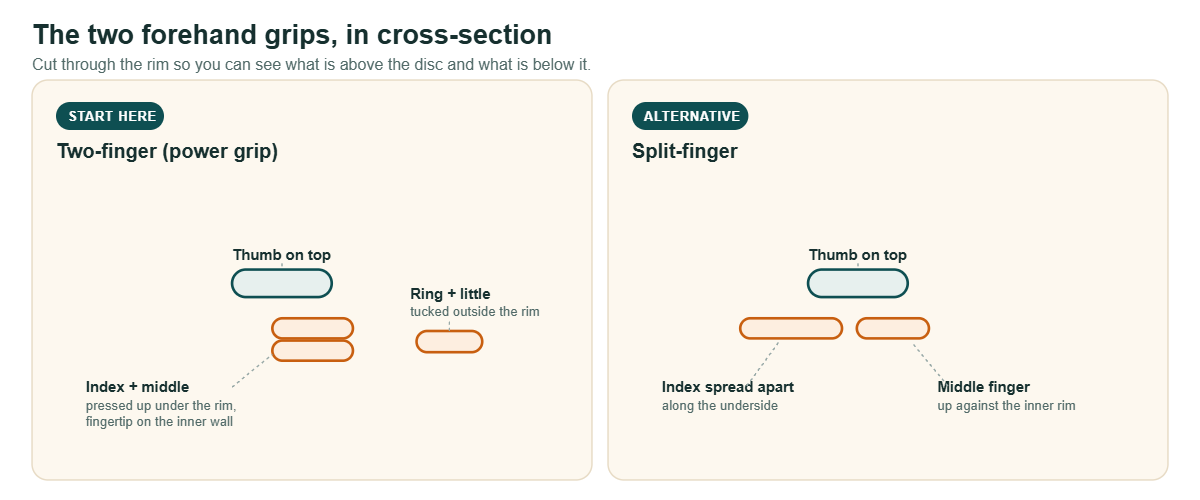
There are two common grips and both work. Start with the first.
| Grip | How to hold it | Best for |
|---|---|---|
| Two-finger (power grip) | Index and middle finger together, pressed up under the inside of the rim, index fingertip touching the inner wall. Thumb on top. Ring and little finger tucked against the outside rim. | Almost everyone. More stable, more spin, easier to keep flat. |
| Split-finger | Middle finger up against the inside rim, index finger spread apart along the underside of the disc. Thumb on top. | Touch and short passes. Many experienced players use it; it gives less power. |
Whichever you use, the disc should feel wedged between your thumb on top and your fingers underneath, not balanced on an open palm. If you can shake your hand without the disc moving, the grip is right.
The throw, in five steps
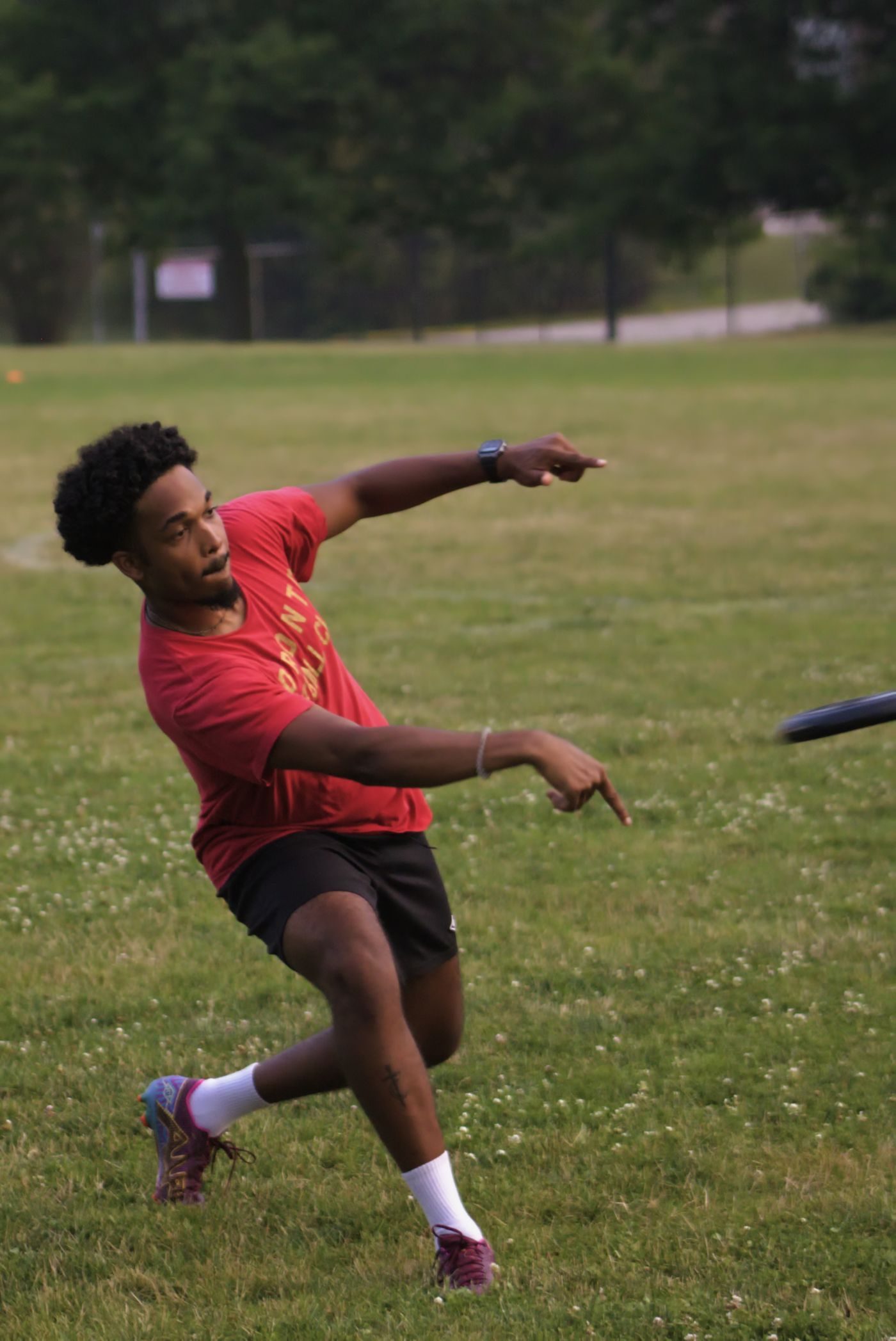
- Stand side-on. Right-handers: left shoulder towards the target, feet about shoulder width. Step out to the right with your right foot as you throw — that step is where your power comes from.
- Keep the elbow in and low. Your elbow stays close to your ribs and roughly still. If your elbow swings out like a tennis forehand, the disc will wobble. The forearm rotates; the upper arm barely moves.
- Cock the wrist back. Before you throw, bend your wrist backwards so the disc points behind you. This is the loaded position. Almost all of the throw happens in unloading it.
- Snap, do not push. Fire the wrist forward. The disc should peel out of your fingers and spin hard. It is a flick — hence the name — not a shove.
- Release flat, nose slightly down. The outside edge should be level or a touch high, and the front edge a touch low. Have someone stand behind you and tell you what the disc looks like at release.
The four things going wrong
| Symptom | Cause | Fix |
|---|---|---|
| Disc wobbles badly and falls out of the air | Not enough spin — you are pushing with the arm | Throw five yards with your elbow pinned against your side. You cannot use your arm, so the wrist has to do it. |
| Disc turns over and dives right (right-handers) | Outside edge dropped at release | Deliberately release with the outer edge slightly up. It will feel like too much and come out flat. |
| Disc climbs, stalls and drops short | Nose up | Aim the leading edge slightly downwards. Think about throwing at the target’s feet rather than their chest. |
| Great at ten yards, unthrowable at twenty-five | Split-finger grip and a loose hold | Switch to the two-finger power grip and squeeze. Short-range touch grips do not scale. |
The single most useful drill. Kneel on both knees and throw forehands to a partner twenty feet away. Kneeling removes your legs and most of your arm from the equation, so the only thing that can generate spin is your wrist. Ten minutes of this does more than an hour of standing practice.
How long it takes
Be realistic: a forehand that flies flat for twenty yards takes most adults somewhere between two and six weeks of throwing a few times a week. It is genuinely the hardest basic skill in the sport, and the fact that yours wobbles is not a sign you are bad at this.
What speeds it up more than anything is throwing with someone who already has one, because they can see what your release is doing and you cannot. Fifteen minutes of pairs throwing before a pickup game beats hours of practice alone.
Fifteen minutes of throwing before every game
Ultimate Together is a new beginner-friendly pickup group forming in the Howell–Brighton area of Livingston County, Michigan, with first adult co-ed games planned for May 2027. Warm-up throwing in pairs is part of the plan for every session, and experienced players who want to help coach are very welcome.
Forehand questions
Why does my forehand wobble?
Almost always because the disc is not spinning fast enough. Wobble is a spin problem, not an aim problem. Pin your elbow to your side, throw short, and make the disc peel out of your fingers with a hard wrist snap rather than an arm swing.
Is the forehand the same as a flick?
Yes. Forehand, flick and sidearm are three names for the same throw — thrown from the same side of the body as your throwing hand, palm facing up. You will hear all three used interchangeably on a field.
Should I use two fingers or the split-finger grip?
Start with two fingers together under the rim. It gives more spin and is far more forgiving while you are learning. Plenty of experienced players move to a split-finger grip later for touch passes, but almost nobody learns on it successfully.
Do I need a forehand to play ultimate?
No. You can play, catch, cut and enjoy a whole season with only a backhand. But defenders quickly learn to stand on your backhand side, and the forehand is what stops that from working — which is why it is worth the frustrating weeks.