Beginner guide
The ultimate frisbee disc: which one, and why 175 grams
Ultimate is played with one specific object: a 175-gram plastic disc about 10.75 inches across. It is not the disc in your garage, and the difference is bigger than it looks.

How much does a frisbee weigh?
It depends which disc you mean. A competition ultimate disc weighs 175 grams, about 6.2 ounces, and measures 10.75 inches (27.3 cm) across. That figure is printed on the top of the disc, and every ultimate game from park pickup to the world championships is played with it. A frisbee off a toy shop shelf is considerably lighter, and a disc golf disc is smaller and denser again.
| Disc | Weight | Diameter | What it is for |
|---|---|---|---|
| Ultimate disc | 175 g (6.2 oz) | 10.75 in (27.3 cm) | Ultimate, at every level. The weight is the same worldwide. |
| Recreational frisbee | About 130–140 g (4.6–4.9 oz) | About 10 in (25 cm) | Throwing about in the park or at the beach. Wham-O’s Pro Classic is 130 g and its All Sport 140 g. |
| Disc golf disc | Usually 150–180 g, with 200 g the PDGA maximum | About 21 cm | Disc golf. Small, dense and sharp-rimmed, which makes it hard to catch and unsuitable for ultimate. |
The practical version: if there is no weight printed on the top of a disc, it is almost certainly not 175 grams, and it will wander in any breeze. What makes a disc official covers the approval marks worth looking for.
The standard, in one table
- Weight
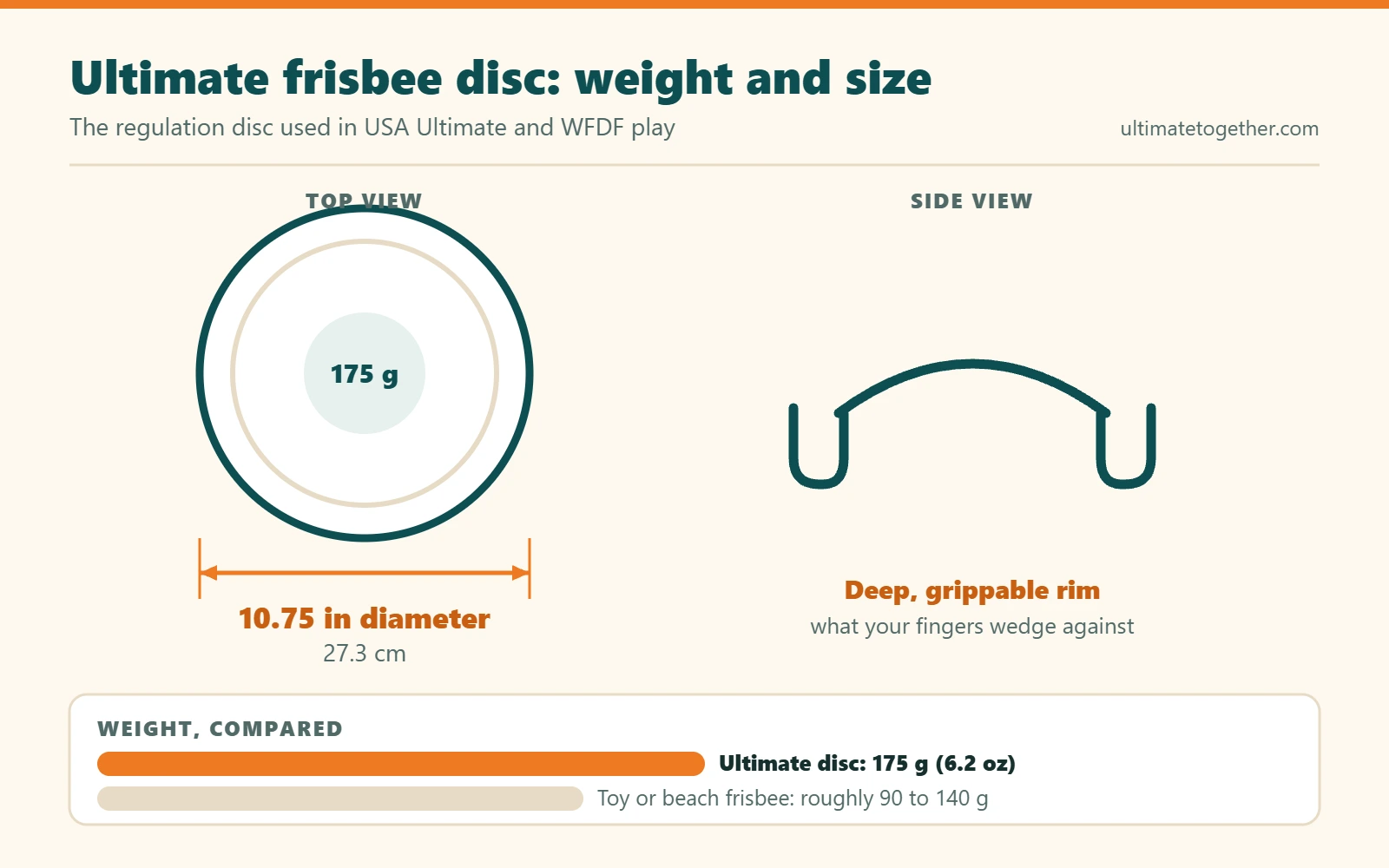
- 175 grams. This is the standard across USA Ultimate and international WFDF play, and it is printed on the disc.
- Diameter
- About 10.75 inches (27.3 cm).
- Material
- Soft, slightly flexible plastic with a deep rim. Firm enough to fly, soft enough to catch without hurting.
- The usual disc
- The Discraft Ultra-Star, marketed by Discraft as the official disc of ultimate, has been the default in North American play for decades. Innova, Daredevil and Aria make well-regarded alternatives at the same weight.
- What it costs
- Roughly the price of a takeaway lunch. One disc lasts years.
Why the weight matters more than the brand
A 175-gram disc carries enough mass to hold a line through wind. Lighter discs — the ones given away at conferences, the classic beach frisbee, most toys marked 130g or unmarked — get pushed around by any breeze and stall early. Beginners throwing a light disc conclude their throw is bad when the problem is the equipment.
The rim shape matters too. An ultimate disc has a deep, grippable rim that your fingers wedge against; a flat toy disc gives you nothing to hold, which is why the spin never comes.
Choosing between discs
| Disc | What it is | Who it suits |
|---|---|---|
| Discraft Ultra-Star 175g | The long-standing default. Stiff when new, softens and grips better with use. | Everyone. If you have no opinion, buy this one. |
| Innova Pulsar 175g | A slightly softer feel out of the packet, with a grippier rim from new. | Players who dislike the break-in period. |
| Daredevil Ultimate 175g | Canadian-made, well regarded in cold-weather play where stiff plastic goes brittle. | Anyone throwing in a Michigan March. |
| Aria / Eurodisc 175g | Discs made with recycled or bio-based plastic, at the same regulation weight. | Players who want the standard weight with a lower footprint. |
| Lighter discs (135–145g) | Youth and school versions. Easier for small hands, less stable in wind. | Children under about twelve. Not for adult play. |
Buying for the backyard, for children or for night games rather than for ultimate? Our guide to the best frisbees covers light-up and glow-in-the-dark discs, discs for kids and the classic beach frisbee.
Breaking in a new disc
A brand-new Ultra-Star is slick and stiff and will feel like it is trying to escape your hand. This is normal and temporary. Discs get better with age up to a point — a scuffed, softened disc with a few seasons on it is what most players reach for.
- Just throw it. A few hundred throws does most of the work. There is no shortcut worth the risk of deforming the plastic.
- Do not leave it in a hot car. Heat warps a disc permanently, and a warped disc will never fly flat again. This kills more discs than anything else.
- Do not use it as a plate, a shovel or a dog toy. Teeth marks on the rim change the flight, and dog discs are made softer for a reason.
- Wash it, do not scrub it. Cold water and a cloth. Grit in the rim is what makes an old disc unpleasant to catch.
- Write your name on the underside. Every pickup group ends up with a pile of identical white discs.
How to throw it once you have one
The disc will not save a bad grip, but it will stop punishing a good one. Start with the backhand, add the forehand over the following weeks.
You do not need to own one to turn up
Ultimate Together is a new beginner-friendly pickup group forming in the Howell–Brighton area of Livingston County, Michigan, with first adult co-ed games planned for May 2027. There will be discs at every session — owning one just means you can practise in between.
What makes a disc “official”?
For a pickup game, official means nothing: any 175-gram disc both teams are happy with will do. For sanctioned competition it is a real category. USA Ultimate runs an approval process that certifies discs for different levels of play, judging each candidate against technical standards and flight tests before it can be used in competition. The World Flying Disc Federation keeps its own approved list for international events.
The discs approved for championship-level play in the United States are the Discraft Ultra-Star, the Daredevil Gamedisc, the eurodisc 175g Organic, the UltiF Pro Frisbee, the X-COM Ultimate Standard and the Yikun Ultipro. Youth play has its own lighter approved models. If you buy any of those at 175 grams you have an official disc; if you buy something else at 175 grams, you have a disc that will be perfectly good for every game you are likely to play this year.
Disc questions
What is the official ultimate frisbee disc?
There is no single official disc. USA Ultimate approves a list of discs for championship play — currently the Discraft Ultra-Star, Daredevil Gamedisc, eurodisc 175g Organic, UltiF Pro Frisbee, X-COM Ultimate Standard and Yikun Ultipro — and WFDF keeps a similar list for international events. All of them are 175 grams, which is the number that matters for everyone else.
What size disc is used in ultimate frisbee?
A 175-gram disc roughly 10.75 inches (27.3 cm) in diameter. That weight is the standard for adult play under both USA Ultimate and WFDF rules, and it is printed on the disc itself.
Can I use a normal frisbee to play ultimate?
You can, but it will not go well. Beach and toy frisbees are lighter, flatter-rimmed and far less stable in wind, so throws wobble and stall. A regulation 175-gram disc is inexpensive and makes an immediate difference.
Is an ultimate disc the same as a disc golf disc?
No. Disc golf discs are small, dense and sharp-edged, designed to fly far and fast at a target. An ultimate disc is large, light-rimmed and soft enough to catch repeatedly with bare hands. The two sports differ just as much as the discs do — we compare them in ultimate frisbee vs disc golf.
Why do players call it a disc and not a frisbee?
Frisbee is a registered trademark of Wham-O, so the governing bodies call the sport ultimate and the object a disc. In casual conversation everyone says frisbee and nobody minds.
How long does an ultimate disc last?
Years, if you keep it out of the heat. Discs actually improve for the first season or two as the plastic softens, then slowly lose their edge shape from ground contact. Most players retire a disc because it warped, not because it wore out.
How much does an ultimate frisbee weigh?
175 grams, or about 6.2 ounces. It is the same weight at every level of the sport and it is printed on the top of the disc. Recreational frisbees are lighter, usually around 130 to 140 grams.
How big is a frisbee?
An ultimate disc is 10.75 inches across, which is 27.3 cm. A recreational frisbee is slightly smaller at about 10 inches, and a disc golf disc is much smaller again at roughly 21 cm.
Why are ultimate discs 175 grams?
Because it is heavy enough to hold a line in wind and still comfortable to catch with bare hands. Lighter discs stall and get pushed off course, and smaller, denser discs sting on the catch. Standardising the weight also means every game is played on equal terms.