For players and organisers
Ultimate frisbee drills for beginners and pickup groups
Ten drills that need nothing but a disc, some cones and the people who turned up. Grouped by what they fix — throwing, cutting, marking and catching — with the time each one takes.
Throwing drills
1. Pairs throwing — 10 minutes
Two people, ten yards apart, alternating backhand and forehand. It is not glamorous and it is the single most valuable thing anyone does all session. Rule: call out what you are about to throw, so your partner practises catching both.
2. Kneeling throws — 8 minutes
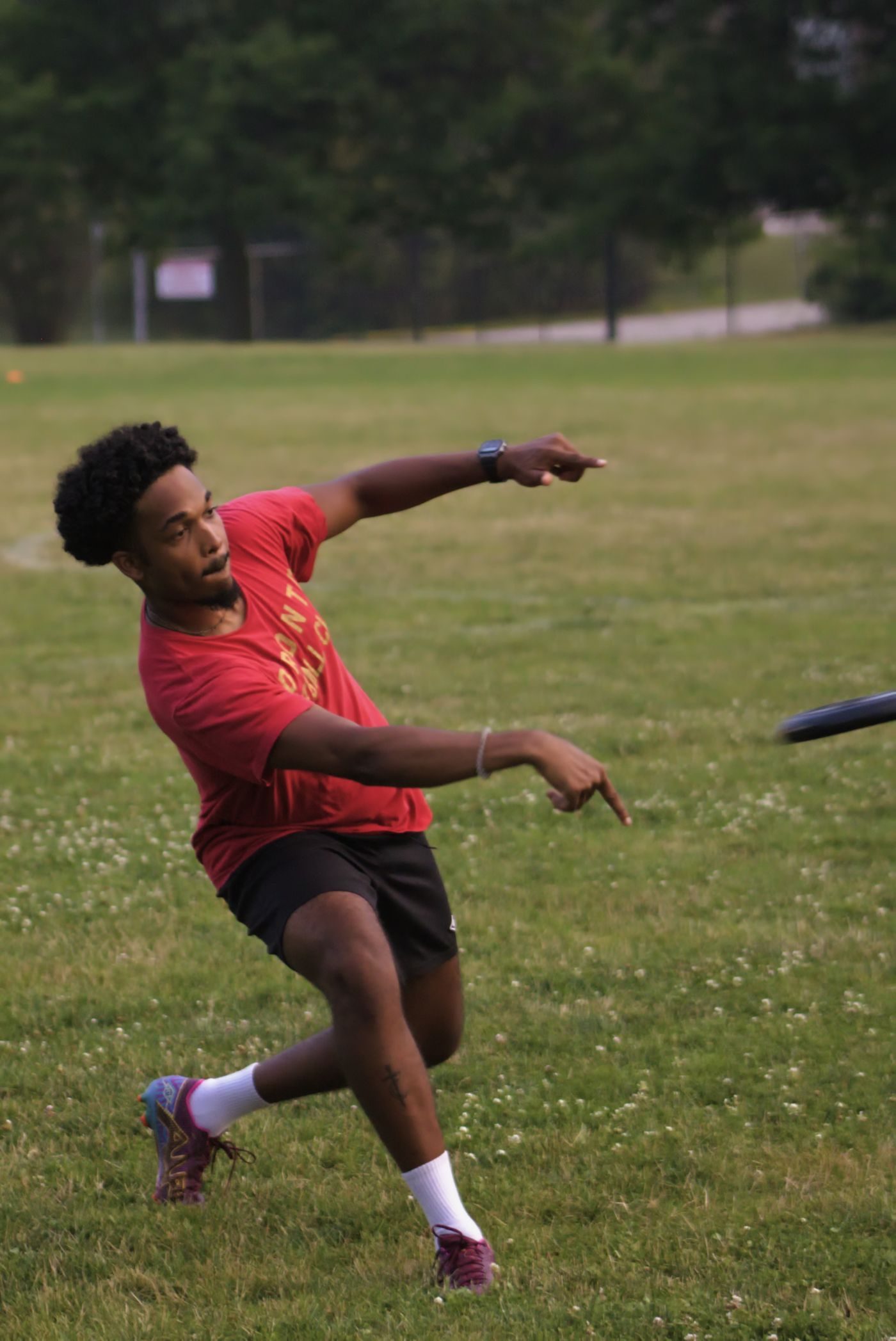
Both partners kneel on both knees, twenty feet apart. With your legs and most of your arm out of the equation, the only thing that can generate spin is your wrist. This is the fastest known fix for a wobbly forehand. More on the forehand.
3. The flat-line drill — 5 minutes
Throw along a fence, sideline or path and watch whether the disc tracks parallel to it or curves away. Straightness becomes something you can see rather than guess at. Have your partner call “flat” or “dropped” on each release.
4. Break-mark throwing — 10 minutes
Add a third person as a passive mark who counts the stall but does not fully commit. The thrower has to step around them and release. Start with the mark at half effort; a full-speed mark against a beginner just produces frustration.
Catching drills
5. Pancake practice — 5 minutes
Short, soft throws to the chest, caught with one hand above and one below, clapping the disc between them. It is the most reliable catch in the sport and beginners routinely skip it in favour of one-handed catches they will drop under pressure.
6. Over-the-shoulder catches — 8 minutes
Receiver runs away from the thrower and catches a disc thrown over their shoulder without breaking stride. This is what every deep cut in a real game feels like, and it is the catch new players find hardest.
Cutting and movement
7. The go-to drill — 12 minutes
A line of cutters, one thrower, two cones. The cutter runs deep to the far cone, plants hard, comes back to the near cone, and catches the disc there. Everyone learns the same thing: the change of direction is what beats the defender, not the speed.
8. Give-and-go — 8 minutes
Throw a short pass, immediately run past your defender, receive it straight back. It teaches the habit of moving after you throw instead of standing and admiring the pass, which is the other great beginner sin.
9. Three-person weave — 8 minutes
Three players move up the field passing and crossing behind the receiver. Good for conditioning, good for teaching people to look up while running, and it warms everyone up without feeling like fitness work.
Marking and defence
10. Mark and pivot — 8 minutes
One thrower pivots to throw; one marker tries to stop one side, counting the stall out loud. Swap after each count. Both roles improve: the thrower learns to use the pivot, and the marker learns that arms and position matter more than lunging. What the force means.
A 20-minute warm-up for a pickup session
If you are the person running a beginner-friendly pickup group, this is a warm-up that works with any number of people and does not leave newcomers standing around.
- 0–3 min — jog and dynamic stretches. Two lengths of the field, then leg swings and lunges. Skip static stretching; save it for the end.
- 3–13 min — pairs throwing. Pair every newcomer with someone experienced. This is also when introductions happen, which matters more than the throwing does.
- 13–18 min — one cutting drill. The go-to drill is the best single choice: it involves everyone and teaches the most transferable habit.
- 18–20 min — rules refresher and teams. Two minutes on the stall count, travelling and calling your own fouls, then split light shirts against dark. The rules worth saying out loud.
One rule for running beginner sessions: never leave a new player in a queue for more than about thirty seconds. Long lines are where people decide not to come back.
Want to help run sessions like this?
Ultimate Together is a new beginner-friendly pickup group forming in the Howell–Brighton area of Livingston County, Michigan, with first adult co-ed games planned for May 2027. If you have played before and would like to help teach, run a warm-up or bring discs, say so when you join the list — that help makes a real difference this early.
Drill questions
What is the best drill for a beginner in ultimate frisbee?
Pairs throwing, by a distance. Ten minutes of alternating backhands and forehands with a patient partner does more for a new player than any team drill, because throwing is the skill that gates everything else.
How do I practise ultimate frisbee alone?
Throw against a fence or wall from about ten feet and watch the disc leave your hand — you are checking whether it is flat and spinning fast, not aiming. Fifty wrist-only snaps a day builds the muscle memory that matters. Running and agility work covers the rest.
How long should a pickup warm-up be?
About twenty minutes, with at least ten of it spent throwing in pairs. Any longer and people who came to play start to lose interest; any shorter and newcomers arrive at the first point without having touched a disc.
Do I need cones to run drills?
Eight cones covers almost everything, including marking out a field. Bags, water bottles and shoes all work as substitutes for drill markers — nobody has ever cancelled a session over cones.