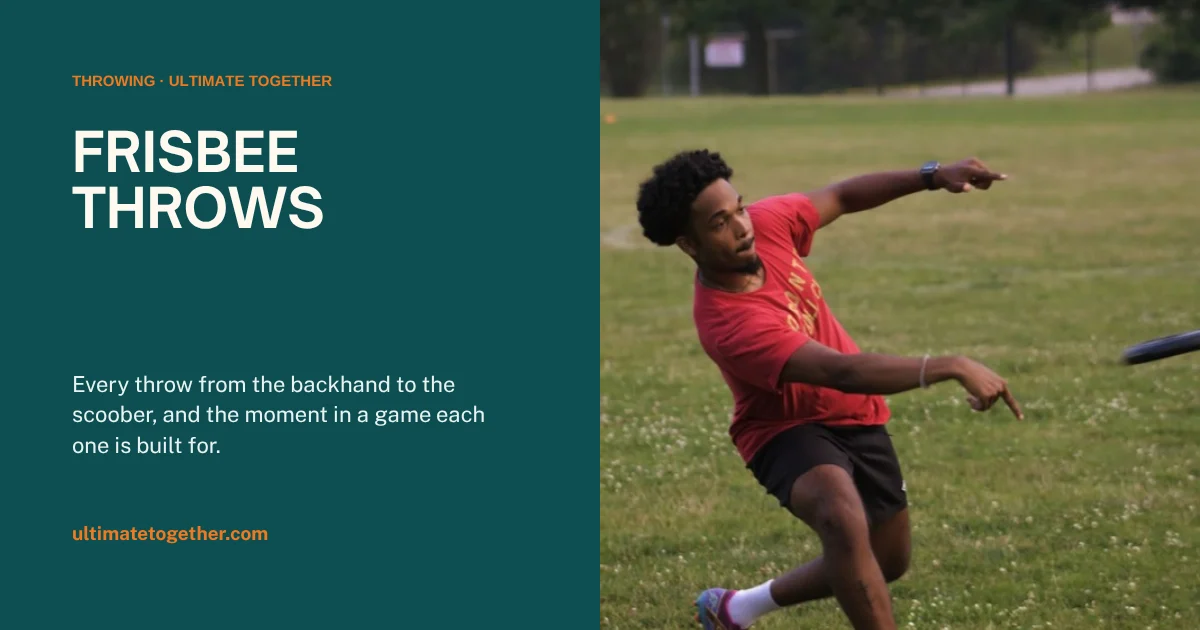
Throwing
Frisbee throws: every throw, and when to use it
There are two frisbee throws everyone needs — the backhand and the forehand — and about a dozen more that get you out of trouble. Here is each one: how you hold it, how it flies, and the moment in a game it is built for.
The short version: learn the backhand first and the forehand (also called the flick) second. Those two handle almost every pass you will ever make. After that the hammer is the most useful extra, then the high and low releases that get a throw past a marker. The scoober, thumber, blade, push pass and air bounce are specialist tools you can pick up later.
Every throw at a glance
| Throw | How it flies | Range | Learn it |
|---|---|---|---|
| Backhand | Flat and stable, thrown from across your body | Short to long | First |
| Forehand (flick) | Flat, thrown from your throwing-arm side | Short to long | Second |
| Hammer | Thrown overhead, turns over and arrives upside down | Short to medium | Third |
| High release | A backhand or forehand let go above the shoulder | Short | Once the basics are solid |
| Low release | A backhand or forehand let go near the ground | Short to long | Once the basics are solid |
| Scoober | Short, upside down, popped over the marker | Short | Specialist |
| Thumber | Overhead like a hammer, thumb inside the rim | Short to medium | Specialist |
| Blade | Released close to vertical, drops fast | Short to medium | Specialist |
| Push pass | Slow, with little spin | Very short | Day one, then rarely |
| Air bounce | Dips, then rises on a cushion of air | Short to medium | Specialist |
| Pull | The long throw that starts every point | Long | When you start playing |
| Huck | Any long pass, usually over 30 yards | Long | When the basics are solid |
1. The backhand
The backhand is the throw most people picture: you reach across your body and whip the disc out in front of you, so the back of your hand faces the target as you let go. Four fingers curl under the rim, the thumb sits on top, and the power comes from your hips and shoulders rather than your arm. It is the easiest throw to make accurate, the easiest to throw a long way, and the one beginners should start with.
Our step-by-step backhand guide covers the grip, the five-step motion and the four most common faults, with drills to fix each one.
2. The forehand, or flick
The forehand is thrown from your throwing-arm side with the palm facing the target or the sky at release. Two fingers go under the rim — the middle finger pressed against the inside edge — and the thumb sits on top. The spin comes from a snap of the wrist, a bit like skimming a stone, not from swinging the whole arm.
It feels awkward for longer than the backhand does, and most players go through a few weeks of wobbly flicks. It is worth it: with both throws you can pass to either side of a defender, which is what makes you hard to mark. The forehand guide walks through the grip test and the fixes for a wobbling or turning-over flick.
3. The hammer
The hammer is an overhead throw with a forehand grip. You bring the disc up past your ear and release it close to vertical, a bit like throwing a ball overarm. It turns over in the air and arrives upside down, dropping steeply into the receiver’s hands.
Its value is the route it takes. A hammer goes over the top of a defender instead of around them, so it beats a marker who is blocking both flat throws, and it drops in behind a defender who is standing between you and your receiver. Against a zone defence it is often the easiest way over the wall of players. It is less accurate than a flat throw and wind pushes it about, so it is a tool for short and medium passes rather than long ones.
4. High and low releases
These are not new throws so much as your backhand and forehand let go at a different height. The point is to get the disc past a marker’s arms.
A low release means stepping out wide with a deep lunge and letting go close to the ground, under the marker’s reach. It is the most useful of the two and works at any range once your throw is steady.
A high release means letting go above your shoulder, over the marker’s arm. It is harder to put spin on from up there, so it is a short-range option, and it helps to be tall.
5. Inside-out and outside-in: making a throw curve
Tilt the disc as you release it and it curves in flight. Players describe the two shapes by where they start and where they end up:
- Outside-in (OI) — released with the top of the disc tilted towards you. It starts outside, wide of the marker, and bends back in towards your receiver. This is the classic way to curve a pass around a defender.
- Inside-out (IO) — released with the top of the disc tilted away from you. It starts on an inside line and bends away, out towards the receiver.
Both work with the backhand and the forehand. You do not need them to play, but once your flat throws are consistent, learning to bend a throw is what turns “the marker has blocked that side” into “I can still get it there”.
6. The specialist throws
Each of these solves one particular problem. Learn them for fun, or when you keep meeting that problem.
Scoober
A short, upside-down throw. You hold the disc with a forehand grip, as for a hammer, but push it up and across your body so it pops over the marker’s arm and flies upside down to a receiver a few yards away. It is a quick escape when you are closely marked, especially near the end zone and indoors.
Thumber
An overhead throw that flies like a hammer, but with a different grip: the thumb goes inside the rim and the fingers sit on the outside. Some players find it easier to throw than a hammer. It is less common, but it does a similar job.
Blade
A pass, usually a forehand, released at a steep angle, close to vertical. With little lift to hold it up, a blade drops quickly, so it is useful for dropping a pass into a small space or getting it down fast in front of a receiver.
Push pass
Held much like a backhand, but with the index finger along the edge of the disc, and pushed out with the palm facing forward at release. It has little spin, so it is slow, short and easily blown about. In games it is mostly an indoor, very-short-range pass.
Air bounce
A throw released low and angled so that it dips, catches the air beneath it and rises again before it reaches the receiver. That rise lets it get under a defender’s arms and still arrive at a comfortable height. It takes practice to control; on a gusty day it is unpredictable.
7. The long throws: the pull and the huck
The pull is the throw that starts every point in ultimate. One team throws the disc from its own end zone to the other team, as far and as high as it can, the way a kickoff starts play in football. Most players pull with a backhand; some use a forehand. The aim is height and distance, so the defence has time to run down the field before the disc lands. How the pull fits into a game is covered in how to play ultimate.
A huck is any long pass, usually over about 30 yards, thrown to a receiver running deep. It is a backhand or forehand thrown with more power and a little more height, and it is the most exciting throw in the sport when it comes off. It is also the easiest way to give the disc away, so it comes after your short passes are reliable, not before.
Which throw, when
| The situation | Reach for |
|---|---|
| Nobody is marking you, or the pass is short and open | Whichever flat throw is your most reliable. Usually the backhand. |
| The marker is blocking one side | The other flat throw: forehand if they are blocking your backhand, and the other way round. |
| The marker is blocking both sides | A hammer over the top, or a low release under their arm. |
| A defender is between you and your receiver | A hammer or blade that drops in behind them, or an outside-in throw curved around them. |
| A zone defence has a wall of players in front of you | A hammer or scoober over the wall. |
| Your receiver is sprinting deep | A huck, backhand or forehand, thrown into the space in front of them. |
| Very close range, indoors or in a crowd | A short flat throw, a scoober or, at a push, a push pass. |
| Throwing into a strong wind | Low, flat and fast, with extra spin. Upside-down throws and floaty passes struggle. |
What to learn first
Most players pick up the throws in roughly this order, and it is a sensible one to follow:
- Backhand, until you can hit a partner ten yards away most of the time.
- Forehand, even if it wobbles for a while. It is the throw that separates a beginner from a player.
- Low and high releases of both, so a marker cannot shut you down.
- The hammer, for getting over a marker or a zone.
- A huck, once your short passes are reliable.
- Everything else — scoobers, blades, air bounces, thumbers — as the game gives you reasons to learn them.
Fifteen minutes of throwing with a partner before each game does more than any amount of reading. Our ultimate frisbee drills include throwing drills that work with just two people, and our frisbee games page has games that sneak the practice in. If you are new to all of it, start with how to throw a frisbee.
Practise them with people who will throw back
Ultimate Together is a new, beginner-friendly pickup group forming in the Howell–Brighton area of Livingston County, Michigan, with first adult co-ed games planned for May 2027. You do not need a single one of these throws to turn up. Join the list, come along, and pick them up as you play.
Frisbee throw questions
What are the different types of frisbee throws?
The two main throws are the backhand and the forehand, also called the flick. The most common extras are the hammer, the scoober, the thumber, the blade, the push pass and the air bounce, plus high and low releases of the backhand and forehand. The pull and the huck are long throws, usually made with a backhand or a forehand.
What is the easiest frisbee throw?
The backhand. It uses a natural across-the-body motion, it is the easiest to throw straight, and it is the one almost everyone learns first. The push pass is simpler still, but it is slow and short and not much use once you can throw a backhand.
What is a hammer throw in ultimate frisbee?
An overhead throw with a forehand grip, released close to vertical. It turns over as it flies and reaches the receiver upside down. Players use it to throw over a marker or a zone defence, or to drop a pass in behind a defender.
What is a scoober?
A short, upside-down throw made with a forehand grip. The thrower pushes the disc up and across the body so it pops over the marker’s arm and flies upside down to a nearby receiver. It is mostly used at close range when a thrower is tightly marked.
What is the difference between a forehand and a backhand in frisbee?
A backhand is thrown from across your body with the back of your hand facing the target at release. A forehand, or flick, is thrown from your throwing-arm side with the palm facing the target or the sky. Having both lets you pass to either side of a defender.
What is the hardest frisbee throw to learn?
For most people it is the forehand, simply because the wrist-snap motion is unfamiliar. Among the specialist throws, the air bounce and the long huck are the hardest to control consistently.